Feeds:
Posts
Comments

Butterflying

I recently became interested in Butterflies mainly through the South African Butterfly Conservation Assessment and their Virtual Museum which encourages members of the public to submit photos of butterflies together with their location. I recently became more involved, joining the Lepidopterists’ Society of Africa and going on some field trips with other members.

Early in January I went to Dasklip Pass & Piketberg with Len and Andrew.
At Dasklip Pass we found nothing special, only common butterflies like:

  • Long-tailed Blue Lampides boeticus
  • Fynbos Blue Tarucus thespis
  • Citrus Swallowtail Papilio demodocus

ground-protea

There was some interesting flowers including the above Ground Protea – probably Protea scabra and this Kukumakranka flower – a Gethyllis sp.:

Gethyllis sp

We then headed to Piketberg. After picking up they key to the access gate we drove out to the communication towers on the end. Here we found a single Protea Emperor Charaxes pelias as well as the usual common species like

  • Long-tailed Blue Lampides boeticus
  • Fynbos Blue Tarucus thespis
  • Citrus Swallowtail Papilio demodocus

protea-swallowtail-resized

Protea Emperor Charaxes pelias

long-tailed-blue-lampides-boeticus
Long-tailed Blue Lampides boeticus

fynbos-blue-tarucus-thespis

Fynbos Blue Tarucus thespis

There were not a lot of plants flowering but there were some nice succulents:
flowers-resized

Towards the end of January I travelled to Greyton – again with Len and Andrew.
Species observed included:

  • Burnished Opal Chrysoritis chrysaor
  • Star Blue Lepidochrysops asteris
  • Braun’s Skolly Thestor braunsi
  • Long-tailed Blue Lampides boeticus
  • Cape Black-eye Leptomyrina lara
  • Citrus Swallowtail Papilio demodocus

brauns-skolly-thestor-braunsi-resized

Braun’s Skolly Thestor braunsi

I also found this very well camouflaged grasshopper:

grasshopper-resized

Probably a Toad Grasshopper Batrachotetrix sp.

Early in February I traveled to Brandvlei Dam (near Worcester) with Andrew.
Species observed included:

  • Cape Black-eye Leptomyrina lara
  • Long-tailed Blue Lampides boeticus
  • Citrus Swallowtail Papilio demodocus
  • Skipper Spialia sp.
  • Dull Copper Aloides pierus
  • Water Blue Cacyreus tespis tespis

Spialia-sp

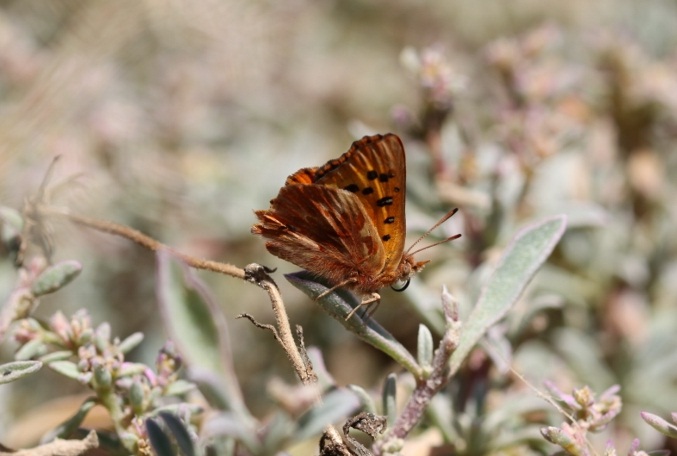
Sandman Spialia sp. Probably the Dwarf Sandman Spialia nanus.

cacyreus-marshalli-web

Geranium Bronze Cacyreus marshalli

aloides-pierus-web

Dull Copper Aloides pierus

There were also lots of Southern Rock Agama’s living amongst the rocks of the dam wall.
agama-web

Southern Rock Agama Agama atra

Matroosberg

Matroosberg at 2249m, is the highest peak in South Africa’s Western Cape. It is situated on a privately owned farm/nature reserve and is well known amongst the 4X4 fraternity as there is a challenging 4X4 route to the top. In early January I traveled to Matroosberg with Andrew & Harald in search of butterflies for the South African Butterfly Conservation Assessment (SABCA). Matrooseberg is situated about 30 mins from Ceres.
The terrain was rugged and the track for serious 4X4s only.

We found a number of species of butterflies including:

The very commom Meadow White Pontia helice helice – a mating pair.

Rock Skolly Thestor petra. An uncommon but drab species living at high altitudes. This one was at 1911 m.

Uranus Opal Chrysoritis uranus

Protea Scarlet Capys alphaeus.

There were other interesting insects:

Antlion, probably Pamexis karoo.

Carpenter Bee Xylocopa caffra.

While it wasn’t peak flower season, there were still lots of interesting & colourful species:

An Everlasting Syncapha sp.

Queen Protea Protea magnifica.

A Visit to the Karoo

Way back in April we travelled to the Karoo NP for Araminta’s first camping trip. The Karoo NP is (aptly enough!) situated in the Karoo close to the town of Beaufort West.

It is a place of spectacular scenery:

I took the opportunity to complete a pentad for the Southern Africa Bird Atlas Project. I managed 43 species with 2 lifers – Yellow-bellied Eromela (Eromela icteropygialis) and Karoo Long-billed Lark (Certhilauda subcoronata). I did not find either of my two target species- Ground Woodpecker (Geocalaptes olivaceus) or Short-toed Rock Thrush (Monticola brevipes). I did see some nice birds however, including:

Rufous-eared Warbler Malcorus pectoralis.

Southern Pale Chanting Goshawk Melierax metabates.

Karoo Long-billed Lark Certhilauda subcoronata.

Verreaux’s Eagles Aquila verreauxii sunning themselves.

There were plenty of mammals also, including:

Rock Hyrax (Dassie) Procavia capensis.

Red Hartebeest Alcelaphus buselaphus.

Cape Mountain Zebra Equus zebra zebra.

Greater Kudu Tragelaphus strepsicoros.

Springbok Antidorcas marsupialis.

We went on a night drive where the best sighting was a glimpse of two Aardwolf (Proteles cristatus).

I saw a few reptiles including this Leopard Tortoise Stigmochelys pardalis:

There were some interesting invertebrates as well, including:

Koppie Foam Grasshopper Dictyophorus spumans.

Scorpion Opistophthalmus karrooensis.

I spotted a number of butterflies which have been submitted to the Southern African Butterfly Conservation Assessment’s Virtual Museum:

As yet unidentified Lycaenidae Butterfly.

Painted Lady Butterfly Cynthia cardui.

As yet unidentified butterfly (Colotis sp.).

Another still to be identified Butterfly (probably an Opal Chrysoritis sp.).

Yellow Pansy Butterfly Junonia hierta.

My First Pelagic Trip

On the 4th of October, 2008 I went on my first pelagic trip. The trip was run especially for Ruth Miller & Alan Davies who are attempting to see more bird species in a year than anyone else. their adventure is called The Biggest Twitch. The pelagic was organized by Zest For Birds a non-profit group that runs these trips regularly out of Cape Town, South Africa.

After an early start we left the harbour on board the Zest II, a converted Navy tender. The harbour brought the usual gulls, cormorants, terns & gannets, as well as a number of Southern Right Whales (Eubalaena australis).

Once clear of the harbour we spotted the first of the pelagic species (and my first lifer of the day) – a White-chinned Petrel (Procellaria aquinoctialis). These were one of the commonest species encountered on the trip.

White-chinned Petrel (Procellaria aquinoctialis)

Also spotted on the way out were Shy Albatross (Thalassarche cauta), Sooty Shearwater (Puffinus griseus), Great Shearwater (Puffinus gravis), Northern Giant Petrel (Macronectes halli), and Pintado Petrel.

Great Shearwater Puffinus gravis

Immature Shy Albatross (Thalassarche cauta)

A number of trawlers were visible on the horizon & we headed towards one. The crowd of birds in its wake was unbelievable!

Cloud of seabirds feeding in the wake of a trawler. That’s Table Mountain and Cape Point in the background.

Our species total rapidly increased: Atlantic Yellow-nosed Albatross (Thalassarche chlororhynchos), Black-browed Albatross (Thalassarche melanophris), two species of timy storm-petrel: Wilson’s  (Oceanites oceanus) and the less-common Black-bellied (Fregetta tropica) which looked like butterflies as they fluttered between the waves.

Black-browed Albatross (Thalassarche melanophris)

The species list continued to increase as we followed the trawler’s wake: Sub-antarctic Skua (Catharacta antarctica) and Indian Yellow-nosed Albatross (Thalassarche carteri). Suddenly a cry went up “White back!” (Only 4 Albatross in the region have white backs.) It was a young Wandering Albatross (Diomedea exulans), the largest of all albatrosses having the largest wingspan of any living bird. Though not fully grown it was an amazing sight and definitely a highlight of the trip.

Wandering Albatross (Diomedea exulans)

The final new bird seen in the feeding frenzy was a single Southern Giant-petrel (Macronectes giganteus) which differs from the Northern Giant-petrel in the green tip to its bill. (The Northern has a reddish-brown tip.)

Feeding seabirds in the wake of a trawler.

Heading back to Cape Town we added one more pelagic species to our lists as fleeting glimses were had of 2 Soft-plumaged Petrels (Pterodroma mollis).

An absolutely fantastic experience that every birder should undertake at least once in their life. I added 16 new species to my life list and had an amazing time.

A Visit to Citrusdal

Some months ago I visited Citrusdal for the Easter long weekend, staying at the Koedoeskop Farm. The weather turned out to be very hot but we still had an enjoyable & relaxing time. I did a bit of birding–including a Pentad for the Southern African Bird Atlas Project 2 (SABAP2), spotted a few reptiles, and also photographed some Butterflies for the South African Butterfly Conservation Assessment (SABCA).

Red-sided Skink (Trachylepis homalocephala) at Koedoeskop Farm.

Agama lizards–probably Southern Rock Agamas (Agama atra) at Koedoeskop Farm.

As well as completing the local pentad centered on Koedoeskop farm, on our final morning I traveled out to Kransvleipoort with a friend chasing the Protea Seedeater (Crithagra leucoptera) & Layard’s Tit-babbler (Parisoma layardi). We were fortunate to get good looks at both species. I also got to tick a Cardinal Woodpecker (Dendropicos fuscescens)–making 3 lifers for the trip.

Verreaux’s Eagle (Aquila verreauxii) catching the early morning sun at Kransvleipoort.

The rocky slopes above the farm were home to the spectacular Paintbrush Lily (Haemanthus coccineus) in full bloom.


Female Red-veined Dropwing Trithemis pluvialis at Koedoeskop Farm, Citrusdal, South Africa.

On the 8th of March, 2008 I visited the West Coast National Park with the Sonmerset West Bird Club. The first great sighting was not however a bird but rather a Caracal. This was my first sighting of this shy & not often seen cat. Unfortunately no photos, though we had quite good but fleeting views.

We visited all of the bird hides in search of waders with some success, though the tides were not ideal; as well as Abrahamskraal waterhole (one of the parks few sources of fresh water).

My bird list for the day totalled 62 species–four of them lifers: Grey-winged Francolin (Scleroptila africanus) which was a target sopecies for me in the park; Lesser Honeyguides (Indicator minor) which were hanging around the nest of a pair of Acacia Pied Barbet (Tricholaema leucomelas) (The Lersser Honeyguide is a parasitic species, laying its eggs in the nest of other species.); Little Stint (Calidris minuta); and Large-billed Lark (Galerida magnirostris).

Male and female Yellow Canaries (Crithagra flaviventris) drinking at Abrahamskraal.

Grey-winged Francolin (Scleroptila africanus) near the Seeburg hide.

Southern Black Korhaan (Eupodotis afraoides)

I also took the opportunity to photograph a few butterflies for submission to the South African Butterfly Conservation Assessment’s Virtual Museum. This is a Cape Black-eye (Leptomyrina lara).

All in all a fantastic day’s outing & the park is highly recommended for all birders–and anyone who enjoys apending time in the great outdoors.

A First Twitch

January 30 saw me set out on my first twitch – to Strandfontein in search of a recently reported rarity, a Yellow Wagtail (Motacilla flava). Last year I missed the Wilson’s Phalarope–it left before I could find the time to see it–soI was eager to try my luck at Strandfontein.

I left late in the afternoon after work & the bird’s location was easily found–just look for the cluster of birders staring out over the pan. Unfortunately, the group had last seen the bird 10 minutes before I arrived & despite searching until the sun began to set I was not able to find it. Nevertheless, it was a good trip. Strandfontein is always productive & I was even able to add 3 new birds to my life list: African Marsh Harrier (Circus ranivorus) and Hottentot Teal (Anas hottentota). On the way in I had wonderful views of a pair of Spotted Dikkop [Thick-knee] (Burhinus capensis) with a young chick right by the edge of the road:

Other sightings included one of my favourite birds, Glossy Ibis (Plegadis falcinellus):


This brief visit produced 37 species. I also met Trevor & Margaret Hardaker. Trevor is a bit of a birding guru & I had been enjoying the pictures and trip-reports on his website for a while.

3 days later I headed back for a second go. It was a Saturday, so I left earlier than my last try. I spoke to a number of birds driving around the site and no one had spotted the Wagtail that day. After about 40 mins of searching I was driving & spotted a flash of yellow. Could it be? Yes!! The Wagtail!! I yelled out to a birder 100m or so away whom I’d just spoken with & he managed to get a glimpse of it before it flew away (not however, before I managed to snap a picture–possibly the worst picture of a Yellow Wagtail ever!–look for the dark blotch perched on a rock right in the centre of the photo):

Luckily we were able to relocate the bird without much difficulty & were able to get good views (and an OK, but not great photo):

There were plenty of other birds around–38 species in total including lots of obliging Barn Swallows (Hirundo Rustica):


On the way out I came across a mass of swallows & swifts feeding on insects:


I can see how this twitching business could become addictive! For better pictures of the Yellow wagtail, see Trevor Hardaker’s photo here.

Mongoose

As an Australian I am especially fascinated by African wildlife for which there are no Australian equivalents–particularly tortoises and mongooses. On a trip some months ago to the Helderberg Nature Reserve I came across a young Small Grey Mongoose Herpestes pulverulentus. It was very obliging and quite photogenic. This is the closest a mongoose has ever allowed me to get.

On another note, I’ve started a Flickr group for the Helderberg Nature Reserve here. You can check it out for many other photos taken by myself and others of this wonderful little corner of the world.

Harold’s Garden

Harold Porter National Botanical Garden is another of my favourite places to visit. It has good birding and a variety of other animals – including various herps. The garden has various sections including a nice wetland that is always full of frogs, mostly Cape River Frogs (Afrana fuscigula) which come in a variety of colours.

Reptiles are often found. The Garden has resident Leopard Tortoise (Stigmochelys pardalis) and Angulate Tortoise (Chersina angulata); and various snakes and lizards may also be seen – including this Short-legged Seps (Tetradactylus seps).

As stated above, it has a good variety of birds – includinbg the very common Karoo Prinia (Prinia maculosa):

Occasionally you may be lucky enough to see a troop of Chacma Baboons (Papio ursinus) which descend from the rocky hillsides to feed in the gardens:

Back in September I went with the Somerset West Bird Club on an outing to Koeberg Nature Reserve and Intaka Island.

Koeberg Nature Reserve is part of the grounds of the Koeberg Nuclear Power Station and consists mainly of Strandveld-one of the four types of vegetation associated with the Cape Floral Kingdom. The weather was grey, cool, & windy; nevertheless, we had some good sightings–including wonderful (if fleeting) views of a Black Harrier.

Can you spot the Black Harrier (Circus maurus) in the centre of the above photo? (I definitely need a longer lens!)

Being spring, there were many flowers:


Best birds of the morning included: Long-billed Crombec (Sylvietta rufescens), Bar-throated Apalis (Apalis thoracica) and Chestnut-vented Titbabbler (Parisoma subcaeruleum)–and of course the Black Harrier. It was cool so few reptiles seemed to be out, but we did spot some Angulate Tortoises (Chersina angulata).

Leaving the Nature Reserve we headed for Intaka Island. Intaka Island is a wonderful wetland environment in the heart of the very urban Century City shopping complex. Breeding was in full swing and we saw breeding:

  • African Spoonbill (Platalea alba)
  • Black-headed heron (Ardea melanocephala)
  • Grey Heron (Ardea cinerea)
  • Purple Heron (Ardea purpurea)
  • African Sacred Ibis (Threskiornis aethiopicus)
  • Cattle Egret (Bubulcus ibis)
  • Red-knobbed Coot (Fulica cristata)
  • White-breasted Cormorant (Phalcrocorax lucidus)
  • African Darter (Anhinga rufa)
  • Brown-throated Martin (Riparia paludicola)

Best bird of the day for me was my first African Purple Swamphen (Porphyria madagascarensis).


African Spoonbills nesting.

African Sacred Ibis and White-breasted Cormorant nesting–notice the urban environment!

White-breasted Cormorant

Nesting Purple Heron – very private!


Southern Red Bishop (Euplectes orix) male.

Older Posts »